Welcome to The Scottish Home. Add this site to your favourites, to read about traditional Scottish homes and gardens, and the joys and frustrations of country living and freelance working. Visit our shop at http://stores.ebay.co.uk/The-Scottish-Home for antique textiles,collectables, and artworks with a Scottish or Irish provenance. All articles are copyright © 2012 Catherine Czerkawska. All rights reserved.
Tuesday, August 31, 2010
Indian Summer
Wednesday, August 18, 2010
More Gorgeous Madeira Work
Sunday, August 15, 2010
Culzean Castle
Monday, August 09, 2010
Great Western Auctions, Glasgow
The Auction House is tucked away beside a lovely old pub called Granny Gibbs. You can read a bit more about Granny Gibb herself, here but meanwhile the present day pub is handsomely decorated with flowers and hanging baskets, and extraordinarily friendly. With time to spare, we went in search of tea. The pub is currently having a new kitchen added, and they aren't serving teas or coffees but the lovely lady behind the bar made us big mugs of tea and chocolate biscuits, and then wouldn't take any payment, but just asked us to put something in the charity box on the counter! I've a feeling this is the sort of thing that only happens in Glasgow and it's one of the reasons why people fall in love with the city!
The Auction Rooms were friendly too - all the staff were cheerful and helpful and its a place I'd be delighted to go back to again. I'm sure I will. The linens were sold quite late in the day, and I managed to buy them, bidding nerve rackingly against TWO telephone bidders. (Not something that usually happens with linens!) I paid rather more than I wanted, but not quite as much as I thought I might have to. A few lots later, I watched several boxes of vintage clothes hitting the roof in terms of price, and was rather glad that I hadn't wanted them! But, of course, Glasgow is a great centre for vintage fashions, with lots of extremely fashion conscious students and other people, and a plethora of gorgeous vintage shops.
Now begins the real work of sorting, and deciding what can be sold, what can't, what needs laundering and ironing - a huge task - and what is perhaps better left in its original condition. There is so much of it, that this could take a whole week. I'll post more about some of the individual pieces, which are stunning, as time goes by. But one little fact emerged which I did not know, and it's part of what fascinates me about old textiles, and how much they still have to teach me. Among the linens was an old, unused, boxed Madeira tablecloth and napkins, very pretty, with its labels still attached. These told me that - as you can see from the picture above - they were made in 'Madeira Island' - of Irish (or Iresh, as one of the labels reads) linen. I've been admiring old Madeira tablecloths for years without ever realising that they were embroidered on imported Irish linen!
Friday, July 30, 2010
The French Connection - Old French Whitework
What really fascinated me about these as well, however, was the fine muslin. I have never seen anything like it - it was like tissue paper - and had been crimped, probably with an old fashioned goffering iron.
I've decided that the time has finally come to let these go, so I'm listing them on my eBay shop this week, but I won't be too sad if they don't sell!
Thursday, July 29, 2010
John Ditchfield's Gorgeous Glass
Although textiles are my passion in life, I have always had a liking for glass of all kinds, whether it be amazing stained glass, or those small, slightly misshapen drinking glasses that you sometimes come across in charity shops, and realise that - against all the odds - they may well have survived for two hundred years and more. But there can be few things as exciting as watching a master glass artist at work - and John is nothing if not a master and an artist. There's something enticing about the way in which a magician of this kind makes the work look easy - when, in reality, it's both difficult and dangerous. Watching him, you forget the high temperatures and the volatility of the material - until, of course, you see the sparks flying!
His pieces have been described as the antiques of the future, by David Dickinson, among others - and I've certainly seen them fetching high prices at auction. You'll have seen them yourself perhaps - paperweights, mushrooms, lilypads (complete with silver frogs) and other natural forms in amazing iridescent colours. But not everything here is in miniature. Outside the studio are a variety of large and striking glass sculptures including the strange flowers above.
But my favourites are definitely the vases. The shapes are simple and very beautiful, while the patterns and colours in the glass are endlessly complicated and enticing.
Friday, July 23, 2010
The Vintage Patisserie
Tuesday, July 20, 2010
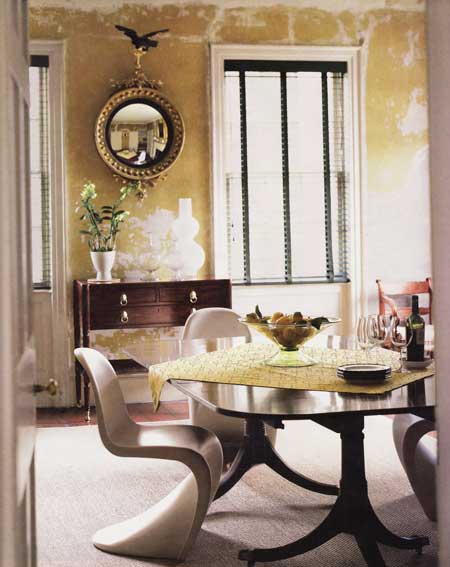
5 Tips on Placing Antiques in the Home
This week, The Scottish Home is delighted to introduce a guest post contributed by London Interior Designer Greg Kinsella. We find these tips fascinating, since it's a sad fact that too many of us impulsively buy wonderful antique or vintage items, but are then not entirely sure how best to display them in our homes!
There are certain rules of thumb you can employ for placing antiques in your home so that they exude just the right amount of charm without being pretentious or over-bearing. Here are 5 tips to help you make the most of your treasured collections:
1. Grouping
Any savvy merchandiser will tell you that placing an odd number of similar pieces of collectible antiques in a display will create the most appealing arrangement. So when arranging items on a shelf, follow this rule to draw the eye. Also you want to be sure not to group items of different genres together. In other words, it is better to have a shelf just for your glass antiques and come up with a different way to display antiques of another material or style.
2. Furniture Placement
To create a specific sense of an particular era, you can make theme placements for your antique furniture that feature a certain style in a room. For instance, if you have a collection of furnishings from a certain era, put them all in the same area and add any knick-knacks that match that time period in the same area, especially lamps and artwork.
3. Colours
When you paint the rooms containing your antiques, try to paint at least one wall the same color tone as your displays and furnishings. For pottery and earthware collections, choose a soft beige or brick red hue that will accent their natural colors If you are working with items like French provincial furniture, consider using a soft yellow or cinnamon color to highlight the decorative inlays and hardware features.
4. Mixing Vintage with Modern
Don't be shy about adding a few antique pieces to your ultra-modern rooms. The contrast between the old and the new accents your antiques and softens the stark effect which often results from the clean, modern lines of contemporary room designs.
5. Lighting
If your beautiful antique collection is not well lit, it runs the risk of not being noticed. Use embedded lights in display cases that eliminate shadows and have different watt bulbs for various items. Also consider overhead lighting fixtures or recessed ceiling spotlights to accent antique artwork or furniture groupings. A pair of vintage lamps strategically placed in your groupings can be used to add splashes of light to accent your most valued collections
Sunday, July 18, 2010
More Bonnie Old Blankets
They look fabulous used as throws on a couch, or chair, or to dress a bed - or on children's beds. You have to be careful that a child with sensitive skin doesn't react to the wool, but I've found these blankets to be so soft that it's seldom a problem. Sadly, here in Scotland, these vintage blankets are so often thoughtlessly cut up for 'dog blankets' which seems like a crime to me.
In the old days, most village weavers would have woven their own blankets which were then taken to be treated at a 'waulk mill'. You can often see this term in placenames, especially in Southern Scotland, and in fact we have the remains of an old waulk mill just outside this village - and documentary evidence that the landowner, up in his big house, would sometimes have been paid rents in 'good woollen blankets'. Given the nature of our winters, they would have been very welcome indeed!
Thursday, July 15, 2010
Lovely Old Buttons, Lovely Old Box
I just love the name of these - 'The Iris Box of Superior Buttons, containing an assortment of the most useful sizes.' These must be Victorian or Edwardian - the kind of buttons that you often find on the back of pillowcases, or sometimes on old nighties. There's something incredibly engaging about the design of these surviving items of packaging - they sometimes seem to retain a flavour of the period more than the items themselves - perhaps because it is so rare to find them in good condition!
Friday, July 09, 2010
Ardkinglas Gardens
To reach this wonderful hillside garden you have to negotiate the famous (or should that be infamous) Rest And Be Thankful. The entrance is well signposted, just before you round the head of Loch Fyne - where you can visit the famous Oyster Bar, if you want to sample some first class seafood! For those with less deep pockets, however, right next to the Oyster Bar is a little garden centre, The Tree Shop, with an excellent cafe where you can get freshly made sandwiches, home baking and a very good cup of coffee. You can also buy plants, shrubs and some rare trees, grown at Ardkinglas, on the other side of the loch. This is a hillside garden, so you need to be reasonably fit to negotiate the many steps, but the pinetum, where you can see champion trees like these, is more accessible. The formidable Scottish midges were having a field day when we went a couple of weeks ago, so be sure to bring some insect repellent. They don't actually like me, for some reason, and only bite me when nothing more succulent is available. I'm delighted about this, but it does nothing to help my companions, especially my husband, who is always mercilessly attacked. The gardens themselves are beautiful and the trees, including the tallest tree in the UK, Abies Grandis, are absolutely wonderful. There's something humbling about standing beneath one of these giants, and gazing up among the dizzying branches. These are monumental trees, trees with personality - well worth a small diversion, if you find yourself heading west from Loch Lomond.
Thursday, July 01, 2010
A Rare Old Scots Lowland Plaid
Friday, June 18, 2010
Dragonfly
Tuesday, June 08, 2010
Textures and textiles.
Sunday, May 30, 2010
Castle Kennedy
Tuesday, April 27, 2010
Old Irish Crochet Lace in Silk
Sunday, April 18, 2010
Dressmaking Samplers
Friday, April 09, 2010
My Gorgeous Chinese Five Clawed Dragon
Monday, March 29, 2010
Time Shift - Irish Crochet and Bel Broid Lingerie
Occasionally, as I've said before on this blog, I come across fascinating things in the bottom of boxes of old linen bought at auction. A couple of weeks ago, I unearthed another of these objects which open a whole world of other interesting references, material for yet more novels and short stories (which I can't find enough time to write although I'm working on it!)
This one is a delicate antique nightie, which I think dates from before the 1920s. My first thought was that it might be French, but it has pretty and undeniably Irish crochet inserts on the bodice and on the little sleeves. It is in some ultra fine, soft, light white material which I think may be old fashioned 'cambric' - a simple, long garment, with the most beautiful whitework embroidery. I can't remember when I last saw such a pretty piece of lingerie. There is a tiny blue label sewn in at the bottom hem, which reads 'Bel Broid Lingerie' and this gave me the clue I needed to find its origin. I found the following on a genealogy site:
Rose Gallagher was born about 1877. She died on 24 March 1941. She is buried at Monaghan, Ireland. Rose and her husband Charles had a factory "The Bel-broid" located in Mill Street, Monaghan, which manufactured hand embroidered linens and lingerie. They operated two embroidery factories, one in Monaghan and one just across the border in Northern Ireland.
So this infinitely stylish garment, which had been stored away in some Scottish linen cupboard for heaven knows how many years, originated in a small factory in Monaghan, in Ireland. The writer and historian in me immediately wanted to know more, much more. But that's one piece of research that will have to be filed away for a little while, since I have so much other writing on hand at the moment, including revising about 120,000 words of fiction before the end of April. But all the same, I may go back to this one. Who was Rose Gallagher? Why did she open the factory, and who were the women who worked there? I'd love to know more. So if anyone out there does know more, perhaps they could let me know, via this blog!
Tuesday, March 23, 2010
Gorgous Embroidered Tablecloths for Spring
I must confess to having a really soft spot for those gorgeous little embroidered tablecloths that so many women seemed to make back in the 1940s and 50s. My dear late mum was one of them, and I still have several of them, beautifully embroidered by her like a little link to my own past. I also have piles of her old Stitchcraft magazines, and browsing through them from time to time, I'm a child again, back at home, with my mum, trying to decide on her next project. Even thinking about it gives me a strange combination of pleasure and sadness! All of which means that when I find a box of beautifully embroidered old linen at auction, as I did last week, I'm disproportionately ecstatic. People who don't have the same passion can never quite understand it, but even my husband, who mostly irons this stuff, was moved to say 'hey - these are so beautifully embroidered. I couldn't tell the front from the back!'
There's an example here, with flowers and butterflies embroidered on linen - all the flowers of late spring and summer in Scotland, honeysuckle, wild roses and many others - exquisite.
I believe, as well, that these little cloths are bang on trend if the country lifestyle magazines are to be believed here in the UK. Sophie Dahl, who begins a new cookery series, on UK television this week, has a fondness for embroidered tablecloths and I can think of nothing nicer, to celebrate Easter, than a proper teatime spread, with cupcakes, dainty sandwiches, and real tea served in china cups - all on these prettily embroidered tablecloths. OK, so we're 'playing at the fifties' a bit! But it's a harmless pleasure, so why not?