Monday, January 29, 2007

Signs of Spring


I hesitate to write about early spring, because I know that somewhere the climate change doom mongers will be down on me with a vengeance. But it generally happens about now, at least it does here in the mild West of Scotland. One day you will be driving along with nothing but naked trees and mud to look at, and then overnight or so it seems, the verges will be white with snowdrops. It happens just as the sparrows, which like to nest in the old house martins' nest just above my study, start to sit on the roof and make a noise (hardly singing, but it is a very welcome sound!) and just about the time that you glance outside at five o'clock in the afternoon and realise that it is still (more or less) light. And it happens at about the same time every year. Not much earlier, not much later.
Of course there will be frosts and winds to come. Of course there will maybe even be snowfalls. But we have seen the signs and we know that the year is on the turn.
Meanwhile, here's a lovely Scottish village sunrise for you. We look forward to the sun coming up each day, because Scottish Power, a company with little efficiency, and less customer care, has seen to it that our street lights have been off for four nights now. South Ayrshire Council tell me that it is Not Their Fault. They wash their hands of the matter. They have reported it to Scottish Power, or Scottish no-power as it is beginning to be called round here, but they have done zippo, zilch, nada about it. When one of my elderly neighbours keels over and breaks a leg, who will be responsible, I wonder?

Tuesday, January 23, 2007

Gifts from Scotland?

Just after Christmas, a friend from England told me how she had been given a beautifully packaged set of soap, body lotion etc purporting to be 'naturally Scottish.' It was only when she examined the bottles more closely that she saw the 'Made in China' label. A quick scan of the company's website revealed that although they have premises in Scotland which work on synthesising and creating these 'naturally Scottish' scents, the products are made elsewhere.
This is relevent to The Scottish Home for several reasons. One is that we are exploring the possibility of including some Scottish made gift items with the lovely old Scottish and Irish textiles we already sell. To that end, we visited a Scottish Gift and Food Fair in Glasgow, last sunday. It was a huge show and we tramped doggedly around, trying to be inspired. But the truth was that so much of it wasn't Scottish, in fact wasn't even English, but consisted of stalls full of imported 'stuff' - the kind of things that my dear late mother used to call 'toecovers' - those utterly useless articles that people bring back from holiday. These are known as 'wee minds' in Scotland, as in 'Och it's just a wee mind.' Which is nice, but it would be nicer still if the wee mind hadn't come half way round the world to the gift shop in Inveraray, Braemar, Pitlochry or wherever else you might chance to visit, only to return half way round in the other direction, in the baggage of some unsuspecting visitor.
Don't get me wrong. There were many stalls with beautifully (and genuinely) Scottish made pottery, knitwear, and jewellery. Actually, there was lots of jewellery - it is a rather oversubscribed area. But we know from past experience as crafters (my husband is still working as a woodcarver) that this is a very expensive show. Not only does it cost a good deal for a stall, but for a small crafter there is the added burden of losing several days' work, as well as the cost of transport, and possibly accommodation.
I'm not talking about the one off artwork, high value end of the craft spectrum here. Such makers are never going to benefit from what is essentially a trade show. And in fact the Scottish Arts Council caters for them reasonably well since they are viewed as part of the arts establishment. But still, there must be many small indigenous businesses - soap and candlemakers, textile artists, cheese makers, honey producers, to name but a few, who couldn't possibly afford to attend. A quick trawl of the internet proves this to be the case. People are out there, making genuinely Scottish, genuinely desirable items. But I wonder how many busy buyers from the various gift shops are prepared to go online, in an effort to support their home industries, when they can buy so many cheap imports in spuriously Scottish packaging.
It would be nice to see the Scottish Executive putting a little money into a smaller scale 'real Scottish Gift Show' for a change. If we don't value our home grown product, who else will?

Tuesday, January 16, 2007

Blow the wind....

So far, it has been a windy winter here in Scotland by any standards, which may go some way towards explaining why we have had more power cuts than I can remember for a very long time.
The latest was last thursday night, when everything suddenly went off at about two o'clock in the afternoon. I had been planning a whole lot of work on my PC, so was fairly frustrated. We got out the candles and the gas ring again, lit the fire, and waited. The wind howled and wailed dementedly around the house. At times like this, it does more than just howl. It rattles at the sash windows, creeps inside and raps smartly on the doors, like somebody demanding immediate admittance. Doors swing open unexpectedly. Bits of the roof creak and groan. Sometimes you would swear that you can hear footsteps rushing up and down the stairs. Which is all decidedly spooky.
I wrote by hand, but sitting upstairs in my study was like being on the bridge of a ship, in a storm. I went downstairs, read, listened to the radio. We took a couple of flasks through to the elderly lady next door. She has a gas fire and plenty of candles, so was very cosy, but there is something about a power cut which instantly makes tea a necessity.
It grew dark. And cold. Had to don cardigans and blankets for sorties out of the living room, into the rest of the house. This old house had no central heating when first we lived in it. Had forgotten just how cold these old stones grow, and how quickly, particularly when there's a wind chill factor involved.
At about 6 o'clock the lights suddenly came on. Not fully though. All the bulbs were dim, slightly better than candlepower but not much. Enough to watch TV but not enough to boil a kettle. At the other end of the village my sister in law could use her PC, but down our end, a couple of hundred yards away, there wasn't enough power. The phone in the kitchen, which has a base unit, went haywire and had to be switched off completely.
We went out to visit some friends. No streetlights. What with the wind and the dark the village had assumed a strange unfamiliarity. We passed a gate behind which a dog was lurking, but he too seemed thrown by the darkness and only wagged his tail, tentatively.
Half way though the evening, everything went off again. And just before midnight, quite suddenly, it all came on. Another friend got home to his farmhouse a little while later, to find that everything had just gone off and stayed off for some twenty hours. They have horses, and he said mucking out in the early morning, with lanterns in the stables, gave him a good idea of what it must have been like years ago. We have, of course, got soft and spoiled, but at least as rural dwellers we know that we can cope if we have to!
So far, we have had few explanations from Scottish Power. The winds were, of course, a factor, but Christmas Day was calm and we were still without power for half the day. A few years ago, there were loud protests about rural powercuts in our neck of the woods. Scottish Power vowed to improve matters and for a few years, everything went smoothly. Now we are back to the bad old days. Right through the autumn, there have been series of mini powercuts, in the middle of the night. Now, a completely disrupted holiday period. Even making allowances for the high winds, somebody somewhere must be cutting corners with manpower and maintenance.

Tuesday, January 09, 2007

New Year, New Book, New Home

Well not quite, but my explanation for my long silence - more than a month - is that we are still involved in major renovations to our very own 'Scottish Home', then Christmas happened, and now I am in the middle of revising an old novel, and writing a new one, as well as formulating an idea for a brand new (and related) non fiction project. When you add to that the fact that we are also working on a relaunch of the whole 'Scottish Home' business, of which more soon, you can see that our feet have barely touched the ground although we did manage to celebrate a traditional family Christmas, with a real tree, holly and ivy, home made Christmas cake, mulled wine and all, in the midst of the upheaval.
To facilitate this, we moved heaven and earth to restore order to our poor house in time for the holidays. The new conservatory is finished, and our conservatory company have moved on to inflict their own particular brand of misery on some other householder. The building itself (more accurately called an 'orangerie' I'm told, because of its construction, though so far I haven't managed to acquire an orange tree) is beautiful. We had no quarrel with the tradesmen; just with the way in which the project was managed, or not managed to be more precise. It was worth it though, just to see it in all its glory with a traditional Christmas tree, big jugs of holly and ivy, fir boughs, candles, pine cones and all the trappings of a rural Scottish Christmas.
The candles came in really handy on Christmas day and again on New Year's Eve, when we had massive power cuts. On New Year's Eve, it was understandable, because it was blowing a gale right across Scotland. Christmas day, calm and fine, was far less explicable. There were several power fluctuations on Christmas Eve. Then we woke up on Christmas Morning to find all the power off. It came back on at 8.30 and went off again at 10.30.
There is no piped gas in our village, only the bottled variety. A few Agas. People were rushing about with turkeys and other joints of meat, like in Dickens' day. My sister in law, who was doing the family Christmas Dinner was one of them. Her daughter has a gas oven, but it's hard to light them without ... well yes, without electricity. Power was restored at 1.30pm in good time for the sprouts and the bread sauce. Still no explanations forthcoming from Scottish Power.
Our old house looks lovely by candlelight, as though this is the way it was meant to be seen. The four hundred year old oak press, with its rich and varied colouring, and wonderful patina looks even better. We set small candles carefully along the 'candle shelf' for Christmas Eve. I remember sitting chatting to the last few guests, watching it out of the corner of my eye, and thinking how very alive it looked at this time, and in this mellow, magical light. When first we bought this piece of furniture, I said that it felt like having an elephant in the kitchen; it was so huge and so strange. There was something very disturbing about it. Now it has settled in, and I find it not just beautiful but inexplicably comforting. There's a tactile, human quality to it. You can lean against it, breathing in the scent of ancient oak and beeswax, and feel in tune with its intricate past, with the hands that made it and polished it. Time has no meaning, and there is something infinitely reassuring about such a presence in a domestic setting.

Saturday, October 21, 2006

Conservatory Horrors (2)

Still trying to write, publicise a new book, and set up a new Scottish Home website in the middle of a building site! I had a week's blissful respite, while I tutored a fiction writing course at wonderful Moniack Mhor in the hills above Loch Ness (see my other wordarts blog, for a fuller account.) My husband had done his very best to clean up before I came home, doing sterling work with brush and mop and duster, but no matter how often you clean up plaster dust, it tends to settle all over again within the next few hours. The low point came on wednesday when the concrete arrived for the base. Actually, the concrete didn't arrive for several hours. The workmen who had been building the walls waited and waited. Eventually they left and an hour later two more workmen turned up, nice polite lads both of them. (All the tradesmen involved have been fine - it's the organisational skills of the company itself that we keep calling into question. ) They waited as well. I made them a cup of tea. At last the concrete lorry turned up, several hours later than planned. 'Are all those pipes to be concreted over?' asked one of the big young men, innocently.
'I don't know' I told him, exasperated beyond belief. 'That's what I'm paying the company many thousands of pounds to tell you!'
Normally I'm not quite so prone to irritation, but we have done so much of our own project management on this job that we feel we ought to be somehow billing the company in return. We have just had to organise our own builder to restructure the drainpipes above the proposed conservatory - a necessity which these so called specialists never even mentioned.
Yesterday I was about to write a cheque for the second slice of money when two thoughts struck me. One, we have had nothing in writing about additional work which the company have agreed to do on a couple of upstairs windows, so I have no idea what they are planning to charge me for this. And two, we haven't seen hide nor hair of a building control officer, when we know that they usually come out to check work in progress, particularly on - as this is - a listed building. Have they even been told that work has started? Until I get the answer to both these questions, I find my hand curiously reluctant to write out a cheque....
There is only one element of progress to report. Several young men energetically barrowed concrete through the house (and were touchingly concerned about not walking on my kitchen floor in dirty boots) Now the new floor has set solid ('turned to stone' as my son described it, when he was a very little boy) and - praise be- I can get into my kitchen without negotiating a piratical plank.
More as it happens.

Sunday, October 08, 2006

Conservatory Horrors (1)

Late last year, having had a number of quotes from several companies, we finally decided who we thought might make the best job of putting a convervatory on to the back of our 200 year old listed, terraced, Scottish cottage.
They came highly recommended by friends who I shall be having words with when I see them, although oddly enough, I don't seem to have met them for a good long while.....
This was to be a replacement for a much smaller conservatory, which had been built by my husband some years previously, and was all we could afford at the time. It was nice enough, but Alan has always felt that it was a 'bit like a corridor' and as our antique Scottish textiles and interiors business is about to expand we felt the need of a bigger room - somewhere to store our lovely old linens, somewhere to dry herbs for our own pot pourri, somewhere to sit quietly with a glass of wine, on a summer's evening, and come up with the next good idea. Somewhere to entertain in comfort. Well, that was the theory anyway.
The conservatory is only part of a much larger plan to renovate the whole house, something which we knew would take a year, and most of our savings. However,since a house is the biggest investment most of us will make in our lifetimes and - when you work from home in various ways as we do - somewhere you will spend a great deal of your time, we thought that major renovations and refurbishments were well overdue. On the first working day of the year, we took our deposit and the completed plans in to the company in question, and signed on the dotted line. Then we turned our attention to our bathroom, which I have written about elsewhere on this blog, and spent some three months turning it into a small paradise. It is now the nicest room in the house, and one where I am inclined to spend more and more of my time for reasons which will soon become obvious. The rest of the house is rapidly turning into a cross between Steptoe's living room (for those of you who are old enough to remember) and a reclamation yard.
The first hitch came with planning. We know from long experience that getting planning permission for alterations to a listed building can take time. The conservatory company should have known that too. To save a little money, we had our own reliable architect draw out plans to the company's specifications. We were also planning two new upstairs windows, which we said that our own builder (who was working on another project for my husband's family) would tackle, although planning permission would be sought for them at the same time as the conservatory.
We had already told the company that my husband would be making a long trip abroad in the summer, so the conservatory would have to be completed by the end of May, or mid June at the very latest, so that he wouldn't be leaving me in the middle of a building site with so much other work to be done (I was on the final draft of a commissioned book, and knew that I would be busy.)
Weeks passed. Then months. The end of March came and there was no sign of planning permission and no word from the company. Eventually we phoned up our local planning department to be told that no plans had yet been submitted to them.
At this stage, when we threatened to withdraw from the project altogether, the company offered to throw in the taking down of the old conservatory, since it was likely that Alan wouldn't be around to do it by the time planning permission came through. They also offered to include a window at a very good price. Our builder went in and ordered it. Planning permission, after a little negotiation, was granted, just as Alan was about to depart for foreign shores. We had tentatively proposed September as a new start date and we were told that the company would 'look after Catherine if you're not back by then - don't worry.' No firm date was mentioned by either side.
After that, we heard nothing from them whatsoever for the whole summer. Nobody told our builder that the window was ready for collection. Nobody phoned me. Nobody emailed me. Nobody wrote to me.
Alan came back much later in the summer, and we wrote to the company more in sorrow than in anger. The response was immediate and irritable. The window had been awaiting collection for months. (But if that was the case, why on earth had nobody phoned me about it? They had my address and phone number. I had been at home, writing hard, all summer.) Moreover, the conservatory panels were already under construction. They were planning to start work on 7th September.
Says who? Nobody had thought to tell us that.
Once more, we capitulated. Trading standards told us that we had so little in writing, that they could sue us for the balance if they wanted to. And they already had about £2000 of our money.
They actually began work during the last week in September. Two nice young men came to dig the foundations of the new conservatory to find the old one ( which they had agreed to take down) still standing. Nobody seemed to have passed that message on to the workforce. Besides that, although their surveyer had visited twice, they seemed completely unaware that there were electrical cables to be isolated.
As I write this, the entire contents of the old conservatory are piled in my boarded up study, there is a large hole outside my back door, and to get into my kitchen I have to walk the plank. Since this is a terraced cottage with a huge garden which borders on a field (no back access) the skip is outside the front door, so everything is being barrowed through the house. You can imagine the mess. We have no idea when they plan to finish. We are not unreasonable. We know that the Scottish weather causes delays. What we didn't realise was that they were going to pass other people's delays on to us. We thought we were employing quite a big company, with enough manpower to cope with autumn rainfall.
The final straw was when the woman in the office told me tetchily that it was taking so much time because everything had to come through the house. As soon as I had hung up the phone, I realised that the inconvenience is all ours. The skip is some 20 feet away from where the men are working, down a nice straight corridor. There can be very few projects where they are so close to the job in hand. Most conservatories are, after all, built onto the backs of houses, so building will invariably involve much greater distances.
No, it is we who have to put up with the mud and the muck and the dust and the noise, and - now that autumn is upon us - the wind and rain and cold. My conservatory plants are all huddled together for warmth under a little glass roofed arbour at one side of the house. God knows if they will survive. The plan is now to finish the conservatory, and the upstairs bedrooms (decoration only!)before Christmas, and tackle the kitchen after Christmas. The bill for the second tranche of payment arrived last week. It said 'Balance due on commencement of works'. The contract I signed, on the other hand, reads that the money is due 'on completion of ground/building works.'
Are we there yet? No way. Are we paying yet? No way.
More as it happens.

Sunday, September 24, 2006

Scottish Country Living


The little cottage which used to belong to my dear mother in law has just gone on the market, and there has been lots of interest in it. My sister in law is busy showing people round, all of whom say how much they like the place. Many of the potential purchasers have been middle aged or older women, or couples, looking to downsize, and settle in a village. The setting is positively idyllic, and there is a great deal to be said for village life, as you head for an active retirement. I'm not advocating moving miles away from family and friends, to a house in the middle of nowhere. But a cottage in a reasonably peaceful village (or on the picturesque edge of one, like this) can be a good move if you are planning to downsize. For a start, village life can be infinitely more sociable than town life. You will have lots of invitations, and there are all kinds of things going on if you want to get involved in the life of the place. The rhythm of the passing year is more noticeable in the countryside, and each season has its traditional events. But perhaps most of all you will probably find supportive neighbours. It's a truism, but people do tend to look out for each other more in villages. We still have a village shop which acts as a dispenser of information. The postman still says hello, and knows who lives where. There's a well attended church, and a caring minister, as well as a pub that serves good food if you don't feel like cooking - and the nearest town, with a small supermarket, an excellent deli, and rail and bus links to anywhere you might want to go, is a mere 10 minutes drive down the road. Add to that, a low crime rate (You can walk home from a friend's house at midnight without fearing that somebody will mug you) and there's a lot to be said for country living.

Thursday, September 14, 2006

Scottish Home Website Coming Soon

I posted about our brand new Scottish Home website some time ago, but it won't be up and running for a few weeks yet. One of our problems is that The Scottish Home is intended to pull together the various aspects of our businesses - my creative writing, my husband's woodcarving, whether sculptures in wood, or restoration work, and our joint interest in Scottish antiques, interiors, arts and crafts, and everything else connected with Scottish homes, traditional and modern. Added to that, we both have websites which are desperately in need of updating. The task is to link all three sites, changing where necessary - no career in the arts stays the same for very long - and including a brand new Scottish retail idea, of which more in due course. It is no easy task, and we are currently working with a web design company to find the best solution to all our requirements. In the meantime, of course, The Scottish Home blog will be continuing - and will continue after the website is launched, because it is here that I can write longer and more informative pieces about various characteristically Scottish antiques, crafts and collectables, as well as Scottish interest posts of all kinds.
This year, September has been unbelievably wet, even here in rainy old Scotland. We usually have a soft, sunny spell about the middle of the month, but it hasn't arrived yet. Instead, I sit here with the rain coming down, and the washing machine full of old linens, which arrived with the marks of years on them. I never know, till they are finished, if the various whitening treatments are going to work or not. Sometimes it takes two or three washes and drying in the sun. But right now, there is no sun!
Last month the hydrangeas in the picture above were in full, astonishing bloom in the garden of a seaside restaurant where I often go for lunch. But there has been so much rain that the blooms are battered and beaten now. It's berry time - rowans, hawthorns, rosehips, elderberries and luscious blackberries - and it has been a spectacularly good year for them too - splashes of colour, scarlet and glossy black, are everywhere. But if the weather continues like this, they will rot on the bushes and shrubs. If the sun comes out for long enough, I'll take some photos and post them - along with some recipes - over the weekend.

Friday, September 08, 2006

Pictures of the Scottish Cottage


My last piece about this delightful little cottage which we are about to put on the market, wouldn't let me post pictures, but for some reason a new post doesn't have that problem, so here they are - You can see the front, which is quite deceptively small - like the Tardis, the cottage is much bigger once you get inside it, (two bedrooms, brand new kitchen, shower room, very large living/dining room) and all the best bits face this most wonderful view, looking across to the ancient woodlands of Kirkmichael House (and south facing, so there's plenty of warmth and sunshine to enjoy!) There is a feature staircase and a delightful hand built bridge across the small stream which is also a feature of the large garden. Most of the garden is down to grass, but if you wanted to grow your own vegetables, and live the good life, there would be plenty of room to do just that.
The whole place is so pretty, and with such a lovely atmosphere, that we would prefer not to sell it, but needs must. People keep asking us if we are going to become property developers, but I suspect not! This was very much a labour of love, and probably a one off. On the other hand, you should watch this space for lots more information about life in Scotland, urban and rural. I'll be featuring some very special gardens, just for the fun of exploring them, so watch out for future episodes.
PS If you like the fish carved newel post, they are a speciality of my woodcarver husband, Alan Lees. They can be customised to suit your particular tastes - he can carve whatever you want. He built the bridge as well, but don't think he wants to go into bridge construction just yet! Visit his website at www.woodarts.co.uk to see more of his work.

Tuesday, September 05, 2006

The Scottish Cottage (2)

Fay's Cottage - the house I was blogging about back in July, is almost finished, and about to go on the market. It has been a long haul, but worth it I think, and nobody who has been in the house has failed to say what a pretty place it has become. Not that it wasn't always a warm, pretty, welcoming cottage - just that now it is a brand new, warm, pretty, welcoming but infinitely bigger cottage, so subtly renovated and extended that it still has something of the character of the much older listed building that lies at the heart of it.
The work involved changing the layout of the original house, to give a bigger bedroom at the front of the house, a brand new shower room, and a small but pretty kitchen with fresh white units and a window (where the fireplace once stood) looking out over the open countryside on the edge of the village. The kitchen itself opens onto a very large sitting/dining room (so you could cook and talk to your guests at the same time) with double doors opening onto decking, and spectactularly beautiful views over the ancient woodlands of Kirkmichael house, just about to be tinged with their autumn colours at this time of year. A hand built staircase (complete with carved newel post) leads upwards from this living room to a light filled upstairs bedroom (though I think if it were mine, it would immediately become a study!) and there is plenty of storage space where a door opens onto the roof space of the old part of the cottage.
Although it retains the look of the original cottage, everything that you would want to be new (like the sewage pipes and the central heating) is completely new. There is a brand new combi boiler to provide oil fired central heating (there is no gas in our village). The interior is fresh and light and clean, carpeted throughout in neutral shades, the whole thing a pretty palate upon which you can impose your own personality.
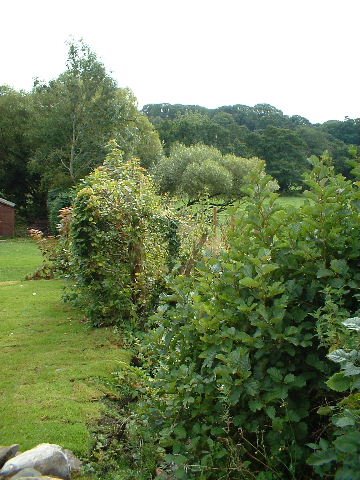
Outside, there is a long back garden fringed by lush hedges, a big plot of land to one side with off road parking, and space for a garage and workshop. Ricketty old wooden garages once stood here, and although they have been demolished, and the ground turfed, there would be no problem with replacing them with a newer garage. The piece de resistance is the tiny, picturesque stream that runs through the garden, with its rustic wooden bridge (Like a willow pattern garden, as a neighbour remarked) constructed by my woodcarver husband. There are even new metal railings, courtesy of my brother in law. The garden is largely grass at the moment, but there would be plenty of room for a vegetable garden and a greenhouse, and even a summer house. These ancient cottage gardens are very fertile, and the garden and the house gets the sun all day long. At this time of the year the house martins are soaring over the garden, preparing for their long journey south - and sometimes from the upstairs window you will see the heron, from the heronry up at Kirkmichael House, flying lazily past, trailing his long legs behind him. In short the cottage, which is close to some of the best golf courses in the country, or indeed any country, is an idyll, a dream place, on the edge of one of the prettiest conservation villages in southern Scotland. As you can imagine, we can hardly bear to sell it, but the right person is out there, and we feel quite strongly that the house itself will surely find them. I would show you a picture, but at the moment, Blogger doesn't seem at all inclined to let me post one!

Thursday, August 31, 2006

Mountmellick - Irish Whitework, Naturally.


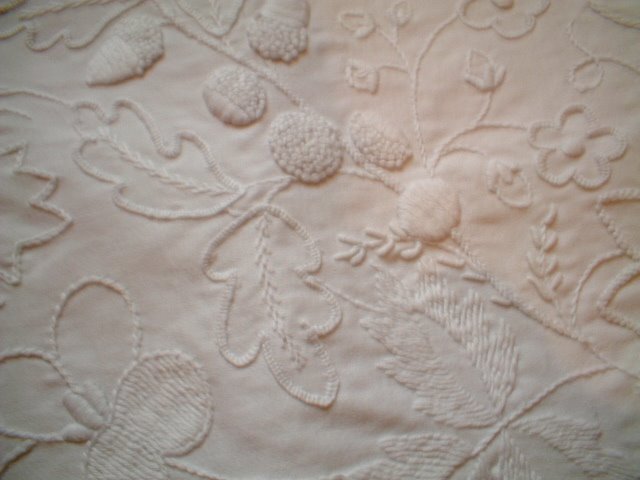
I had been hoping to find a piece of genuine Irish 'Mountmellick' embroidery for some time, and suddenly there it was, right at the bottom of a cardboard box of old linen, bought at auction recently. This was a nightdress case, heavily embroidered with whitework flowers and leaves on a heavy, almost satiny cotton. It even had the characteristic fringed edge, although that had suffered some damage, as had the body of the case, which was missing a corner. It looked a bit as though someone or something had taken a wee bite out of it! But the embroidery itself was mercifully free from faults, and as beautiful as I had hoped it would be, complete with oak leaves, acorns, grapes and passion flowers.

It was, seemingly, the natural plants which grew along the Owenass River which inspired these designs: blackberries, oaks and acorns, roses, woodbine, wild clematis. Passion flowers seems to have been a favourite cultivated plant to be depicted, while butterflies and seashells are sometimes found. The pieces were useful as well as beautiful, and most Mountmellick can be washed, even at high temperatures. In fact you will often find that the more a piece is laundered, the better it looks, with a softness and patina that is hard to fake.

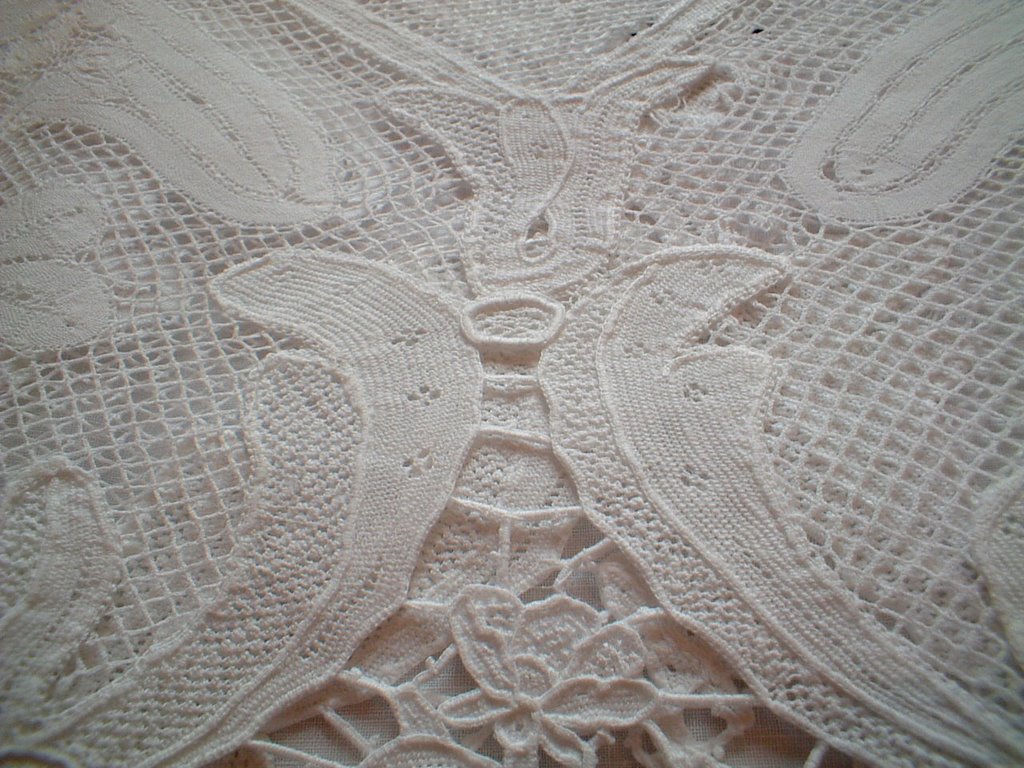
The history of Mountmellick, is part of the wider history of lacemaking in Ireland. One Joanna Carter received an award in 1816 for developing new embroidery stitches and by 1825 she had set up a small school in Mountmellick, County Laois, to teach the skills to the young women of the district. Like many of these industries, it was thought to be a good way of encouraging women to contribute to the economy of the family. In the early 19th century we find a genuine movement to set up schools of needlework and lace in Ireland with Limerick and Carrickmacross Laces, as well as impossibly fine Irish crochet, Irish whitework, and of course, Mountmellick itself.

It fascinates me how much of this obviously Irish embroidery and lace turns up here in the West of Scotland. Sometimes it seems as though every other piece of lovely old linen is decorated with shamrocks, or of obvious Irish provenance, like my piece of Mountmellick. I only wish the textiles could tell me their stories. But somewhere at the back of my mind is a vision of a woman who learned her craft at home in Ireland, but who - like some of my own forebears - crossed the sea, in search of work, a viable way of life, or even an escape from famine. I think about her quite a lot. Was she homesick, here in Scotland? When she stitched the flowers of the Owenass River, so beautifully into her nightdress case, did she still think of that place as home? When she worked those fine white shamrocks into the fine white linen of a small tablecloth, was she thinking of Ireland? Who was she? And above all, why did nobody remember, and keep these precious textiles in the family? It makes me quite sad to think of her, but at least the work of her hands is still loved and appreciated, usually by other women, all these years later.
For more information about Mountmellick embroidery, go to http://islandireland.com

Saturday, August 26, 2006

Caring for Vintage Scottish and Irish Linens


There is something at once poignant and magical about buying - as I so frequently do - boxes of old linen at auction. They are my first and best love, and I've collected them along with other textiles for many years, as well as more recently setting up an online shop so that other fans of old linen and lace can browse, and perhaps add to their own collections. Because these domestic textiles tend to be under appreciated (and somewhat neglected) here in South West Scotland, I often find myself having to give them a great deal of TLC before they are fit to be seen. Some of them arrive clean and starched and sweet, but so many of them have been stuffed into trunks and boxes and horrible old suitcases for years on end: they can be crumpled, stained, dusty, dirty and extremely smelly, if the truth be told. I look upon the process of preparing them as a rescue mission, and it is extremely time consuming - but fascinating too. Even though you have a good rummage on viewing days, you are never quite sure what you might be going to find at the bottom of the box. Mostly it will be a miscellany of rather ordinary crochet doilies, but just occasionally something more interesting turns up.
They all have to be sorted, examined, assessed. Can they be soaked in a solution of stain remover or are they just too delicate? Chlorine bleaches are out of course but there are some wonderful new products on the market which are much gentler. Big damask tablecovers and linen bedding can withstand high temperature washes. Some of the more delicate, lacy or whitework pieces need gentle soaking, hand washing, and rinsing with the shower - rubbing and squeezing of old and delicate fibres can do real damage. I know somebody who simmers old muslin baby dresses in a saucepan with soap, and claims that it is very effective, but I haven't ever had the courage to try it for myself. Nevertheless, when occasionally presented with a baby gown or something similar which is so stained and discoloured as to be almost beyond rescue, I have experimented with successive soakings, and changes of water, over quite a long period - 24 or even 48 hours, before washing, with a fair amount of success.
Dirt, in the fibres of an old piece can do real damage, so your vintage and antique linens should be kept as clean as possible. Lavender in the shape of bags, or a few drops of oil in your ironing water, will deter moths, and keep your linens smelling fresh and sweet. Keep delicate pieces out of direct sunlight, and if you are storing them for any length of time, use acid free tissue to wrap them. But I am of the opinion that we should be using these lovely old linens, to dress a table, or a bed. They have been created with great skill, by women who are long gone; they are a lovely tactile link with the past, and by using and admiring them we are somehow acknowledging all the talent that went into making them so many years ago.

Friday, August 11, 2006

New Scottish Home Website

My apologies to any regular visitors for the slight gap in posts. This is because we have been setting up a companion website to this blog, also called The Scottish Home. It should be going live within the next week or so. It is a very visual and quirky site, with sections on Scottish country houses, town houses, gardens and collectables. You will find it crammed with images, and snippets of information about Scotland. We will be changing it to reflect the changing seasons, and showing a very personal selection of all kinds of Scottish homes from cottages to castles, and their gardens, both ancient and modern. We will be exploring interiors, both traditional and contemporary and we will be looking at the hidden histories of some of Scotland's cities, towns and villages. You will also find Scottish crafts, textiles and collectables, as well as links to our eBay shop where you can buy some of them, if you want.
This blog will remain as the regularly updated companion diary/ magazine to the website. It is here that you will find longer articles about all things Scottish, from traditional customs and beliefs, to explorations of rare Scottish textiles and their history. And of course there will also be a good helping of fiction, because wearing my other 'hat' as a novelist and playwright I generally find that Scotland figures largely in my work.

Thursday, July 27, 2006

Driftwood from Ballantrae Beach


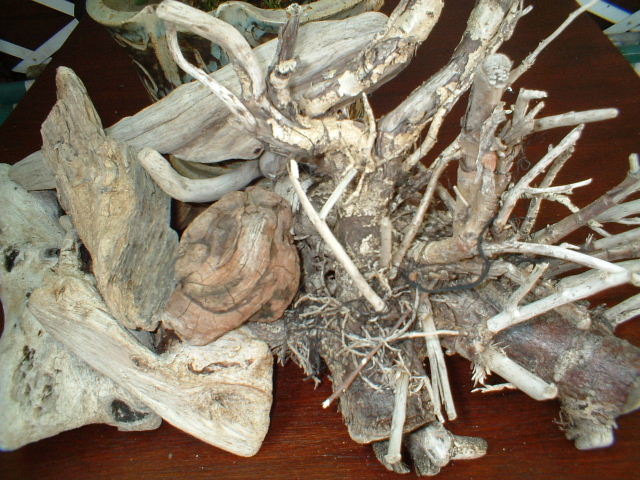
Ballantrae is a small village in the far south of Ayrshire and - sometimes - an excellent source of the driftwood that my husband often uses in his artworks. We went down there yesterday on a fine afternoon, but winter and spring, after the storms, are much the best seasons for driftwood and now most of it has been cleared away by the council, so that the visitors won't be hindered as they amble along the beach. Ballantrae was once a thriving fishing village, with many ring netters and other boats, with the characteristic BA registration. There is a village street which more or less turns its back on the sea, a ruined castle and a picturesque harbour, with only a few tiny boats moored there. Down along the shore is a lovely little row of fishermen's cottages which have been renovated and painted in bright colours, and an old clinker built open fishing boat, drawn up on the hard. This is a beach where terns nest and from which you have views of Ailsa Craig, now a bird sanctuary, and Arran, from an unusual angle, with Holy Isle clearly visible as a separate island (It sits in Lamlash Bay and from most of the Ayrshire coast, it looks as though it is part of the main island.) On a clear day, you can see the Kintyre Peninsula, and the Antrim coastline from here and it becomes very easy to see why the so called Scottii, the Dalriadan celts, came over from Ireland to colonise this place. Yesterday though, it was all misty and distant with smudgy suggestions of other lands. The only people on the beach were two women, walking a pair of dogs, and a couple of wee boys and a girl, who had set up sea fishing rods and were hoping for big things. Children in this part of the world have summers that most city kids can only dream of. There's an optimum time, my own grown-up son tells me, when you are 'old enough to go out and about on your own and young enough to get away with it.' He remembers playing 'chases' up hill and down dale, like the legendary William Brown and his outlaws, and already thinks about that time with a certain amount of nostalgia.
Down at the harbour, a retired couple who had driven down from nearby Girvan, were perched on the sea wall enjoying the sun, while a trio of teenagers with rods were digging for lugworms for bait. We stood back, older and wiser, and agreed that they hadn't a hope. They were digging and then standing back to survey the results, thus giving the worms plenty of time to burrow back in. The technique is to dig, and then pounce on them immediately. We spent a few summer mornings in Gigha, doing just that, when our son was small but I can't recall that we ever caught many fish. It was my dad who was the lucky fisherman.
At Ballantrae, we poked about the beach for a while, gathering one or two interesting driftwood pieces, which might be useful as part of something larger, and then came home again. In due course, you might well see some of the results of our beachcombings on the Scottish Home. Driftwood is imported into the UK in huge quantities these days, but there is nothing quite like the natural sculptures to be made from the real, indigenous product. And if you aren't sculpturally inclined, these sea bleached pieces can still make an interesting addition to your garden.

Tuesday, July 25, 2006

Garden Sculptures in Wood


My husband, Scottish sculptor and woodcarver Alan Lees, has often been commissioned to create large, outdoor sculptures in wood. These days he finds it too physically demanding to make the ten or fifteen foot high artworks which he used to make, and he tends to create slightly smaller pieces, although his inspiration always seems to be on a large scale. If you want to see a great quantity of his work all in one place, go to the excellent Kelburn Country Park, at Fairlie, just outside Largs, on the North Ayrshire coast. He has contributed a number of extraordinary pieces to Lord Glasgow's 'Secret Forest' including a three dimensional 'Green Man' in solid oak. One other life size carving is in the Burns Centre in Alloway, although this is a source of constant frustration to the artist as well as to many visitors, since the shop manager there persists in using this life size realisation of Robert Burns' Tam O' Shanter and Meg the Mare, entirely hand carved in Scottish lime, as a 'point of sale' display piece - blocking the visitors' view of it with assorted cheap souvenir items. Yeuch. We are quite used to getting irate phonecalls about it from outraged Canadian and American visitors, but since the sculpture belongs to the council, not us, there isn't a thing we can do about it. (South Ayrshire Council are not noted for their extensive appreciation of the arts!)
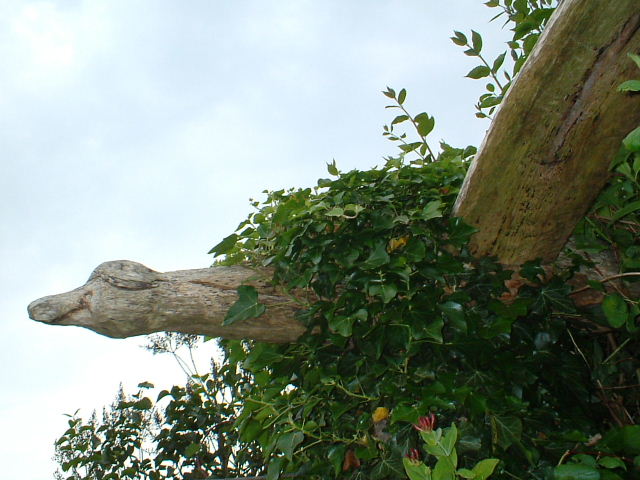
Working on large carvings like this, though, can be a thankless task. People have no idea of the time and work involved and while they will pay many thousands of pounds for a mass produced item such as a car, are curiously reluctant to pay an artist or craftsman for his time. On one memorable occasion, a client (better remain nameless) asked Alan to travel fifty miles in order to estimate for carving a 40 foot high dead tree into an interesting shape. When we got there, we found they had a budget of £200! We don't have many sculpture in our own garden, but the big bird, above, is one. Now that the ivy and the honeysuckle have done their work, I think it looks wonderful - as if the bird is flying out of a big green cloud. It won't last forever, of course, but the gentle, slow decay of these outdoor pieces is a part of the process. The older they are, the better they seem to look.

Tuesday, July 18, 2006

The Critter in the Kitchen


When describing the idylls of country living, most lifestyle magazines will tell you nothing about all the creatures who will not only share your garden, but occasionally decide to invade your house as well. This morning, when I went down to make my tea (real tea-leaves, real teapot, naturally) there was a critter in the kitchen. I heard a sudden, frantic scuffling behind the dustpan and brush, but couldn't see what it was, except that it looked quite big. Aaargh. I went out, shut the door, did something else and went back in again, wondering if I had been mistaken. But there it was again, that sudden convulsive scrabbling movement, this time in the vicinity of the dresser. Then all went quiet. I closed the interior door, opened the outside door, made my tea and hoped for the best.
Most summers, we have various specimens of the local fauna that decide that they would prefer to share our living space. There was the summer night when my son came into the living room and said that there was 'a very very very large moth' in the kitchen. It wasn't a moth at all. It was a disorientated pipistrelle bat. We put the light off and opened the back door (usually the best way of dealing with such intrusions, since they want to get out just as much as we want them to go!) But on this occasion it didn't leave. Somehow it found its way through into the study where one of my husbands woodcarvings - ironically enough a large wooden pillar, carved with bats (honestly!) - was waiting for installation in somebody's garden. The bat was found clinging to it the next day. Very gently we managed to transfer it outside, and put it well away from marauding cats, in the shade, to await nightfall.
Spring and autumn bring an annual invasion of little field mice and shrews. Sometimes young swallows fly in the windows. Once it was a blue tit that took up residence in the kitchen and definitely didn't want to leave. We have had baby hedgehogs ambling up the hallway, and rooks in the chimneys. Yesterday, standing in the kitchen doorway, I saw the flash of a mobile reddish brown sausage, marking the passage of stoat or weasel, I'm never sure which.
Worst of all, though, are the enormous garden spiders that seem to venture doggedly indoors at this time of year. I don't mind the smaller variety, but the other night's intruder was huge. I never kill them. Can't stand the squashing. I just put a glass over the top, slip a card underneath and evict them.
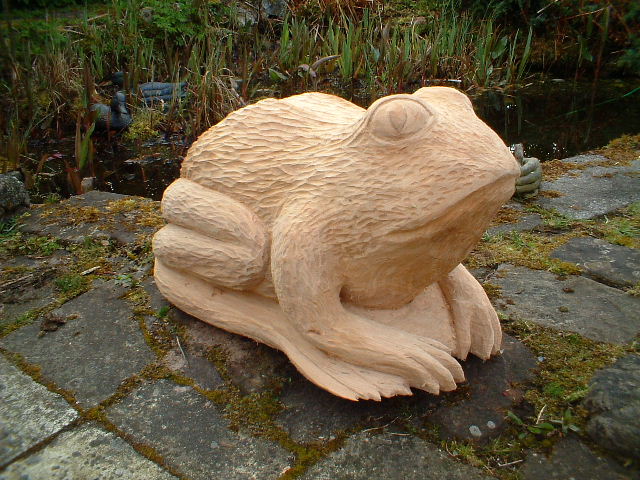
This morning's critter? Well, I just went out the back door myself and almost tripped over an extra large frog, making its hesitant way out, at the same time. I stood back and watched it hop off. Sighs of relief all round. I rather like frogs, which is just as well, because having a garden pond not far from the back door, we have lots of them. Oh and the wooden frog in the illustration? That's one of a pair of larger-than-life sculptures that my husband made for a country park. I'm glad my visitor wasn't quite that size!

Monday, July 17, 2006

Favourite Plants from a Lowland Scottish Garden


I went browsing around our local garden centre today, on my own, and realised how blissfully happy it made me. I've just sent back the revised proofs of my new book about the history of the beautiful little Isle of Gigha, which has also figured largely in my fiction, and I felt justified in treating myself to a coffee and some 'time out'. Later this week, if our current heatwave continues, I may take myself off to Culzean, or even as far afield as Logan Gardens, down in Galloway, all in the name of research for the Scottish Home (and garden, of course!)
As usual, I found myself driving home with an array of slightly battered plants which I had found on the half price trolley - a leggy Cotinus, with lovely golden foliage, and a couple of Prunus, Oshidori and Triloba. I do so love rescuing things and restoring them to useful life - textiles and plants. At the moment, they are having a long drink since they were completely dried out. I only intended to buy the Prunus (Pruni?) but the Cotinus more or less demanded to be rescued. Now I have to clear a space for them, which will prompt me to do the necessary work in my overgrown, summertime garden.
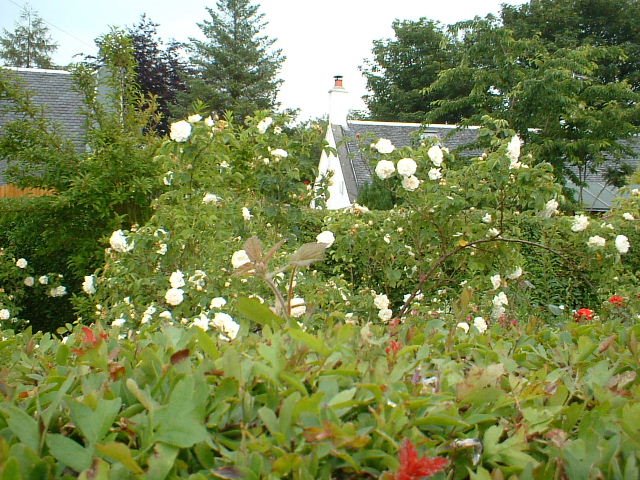
But it also prompted me to think about my favourite plants, ones which seem to characterise a Scottish cottage garden in summer. Roses come first, of course. Both I and my next door neighbour have a lovely old white Scottish garden rose called The Jacobite Rose, which is said to date from the time of Bonnie Prince Charlie. Besides that I have a Himalayan rose, Paul's Himalayan Musk, bought many years ago from rose grower par excellence, David Austin, down in England. It seems to thrive in the mild, wet climate of the West of Scotland.
Lavender is my other 'must have' - but I tend to grow them in pots. Our garden is 200 years old and the soil is a bit rich for lavenders, besides which we usually have rather a lot of rain. I grow different varieties, including the wonderful named 'fathead' in pots, so that I can keep them reasonably dry. And some of them are rather frost sensitive so I bring them into shelter (although not indoors) in winter.
I have a a huge scented jasmine, growing up the side of the house which at this time of year, July, is at its best. This originated in a tiny pot plant (another bargain) bought from a local supermarket, as a house plant. I found that it did very well outdoors, and gradually the size of the pot increased. Now, it sits on an old patio, which is covered with small and very pretty Victorian flagstones, but the roots have gone through the bottom of the pot, and through the flagstones too. At the moment it seems amazingly healthy, and the scent, which floats through my study window every evening, is wonderful, so I'm not about to tamper with it!
I love lupins too. I know people almost consider them to be weeds these days, but they are prolific, and colourful, and the smell reminds me of my childhood. And if you cut off the dead heads pretty consistently, they will repeat flower right through the summer.
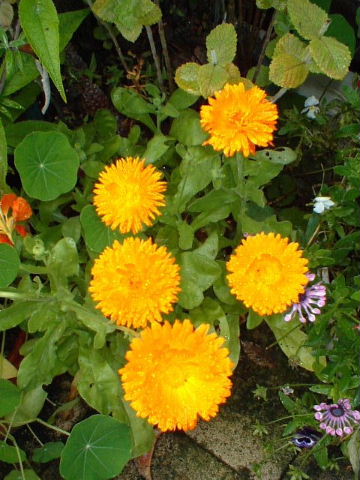
One of my all time favourite summer garden flowers is the cheerful pot marigold, not to be confused with its stiffer, starchier and (in my opinion) less attractive French cousin. You should look for calendula seeds - it isn't too late to plant some even now, because they flower well into the autumn. As their name suggests, they grow very well in pots, as well as among other annuals, and if you dead head them they will flower for months. The calendula is a highly desirable herb, with lots of health giving properties - calendula ointment is particularly valued for its healing properties.
Finally borage, with its bright blue flowers, is a must. Its old name of 'bee bread' tells you how much these busy insects are attracted to it. The leaves and flowers were once used to add a cool cucumber scent and flavour to summer drinks, but - if I can find the time - I will freeze the bright blue flowers into ice cubes, one per compartment in a tray - and then keep them for Christmas. If you remember that you have them, and bring them out for Christmas drinks parties, your guests will be amazed!

Friday, July 14, 2006

Scottish Shortbread


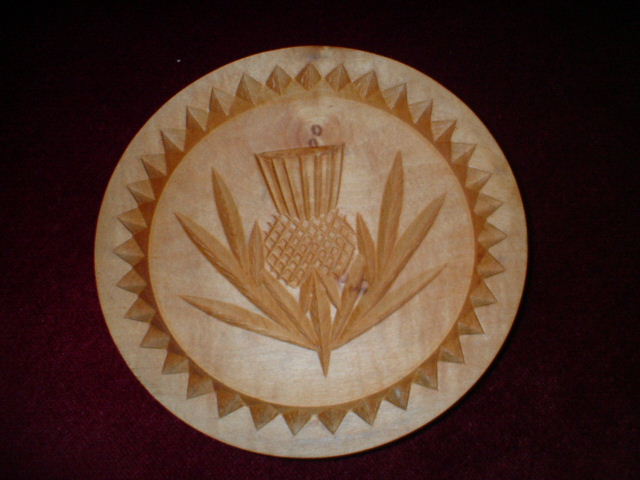
This week, one of the listings in my Ebay "Scottish Home" Shop, is a shortbread mould, carved with a thistle. I find that these little wooden pieces of Scottish kitchenalia are always very much in demand, although I'm never very sure whether people want them to use, or simply to decorate a rural kitchen.
Shortbread is one of those deceptively simple things that can turn out as variable as the people baking it. It was one of the first things we ever made at school, right after the 'fairy cakes' I seem to remember, but it was quite tricky. Essentially though, you need good butter, fine sugar (so called caster sugar) and plain white flour, not strong bread flour, which will give your finished shortbread too coarse a texture.
I can only remember recipes in ounces. but shortbread works on proportions, ie 12 oz flour, 8 oz butter and 4 oz caster sugar. If you can use sugar which has been flavoured with a vanilla pod in the jar, so much the better.
You sift your flour into a bowl, with a good pinch of salt, and then rub in the butter until the mixture 'resembles fine breadcrumbs' as our teacher used to say! Gently stir in the sugar, and then (here's the tricky bit) carry on rubbing. You should find that the mixture gradually begins to come together, as the butter becomes softer, until - kneading it gently - you will find that you have a ball of dough. Set it aside in a cool place for a while, to firm up, before you try to roll it out, otherwise it will be a bit sticky. The trick to using the wooden shortbread mould is to roll out your shortbread quite thickly, flour your mould, and then gently lift the shortbread slab over the mould, and press it in, (You can do this with a floured rolling pin if you like) cutting off the residue round the edges with a knife, much as you would if you were making a pie. This remaining dough can be rolled out again to make more rounds. Our teacher used to tell us that shortbread was fatty, so the baking tray didn't need greasing, but if you aren't using a non-stick tray, it would do no harm to grease it a little. Prick the biscuits with a fork so that they don't bubble up during the cooking process, and if you like, you can also mark them with a sharp knife, into the little triangles known in Scotland as 'Petticoat Tails' because of their shape.
Of course you can make perfectly good shortbread without using a mould, but using biscuit cutters instead. The shortbread should be baked in a moderate to cool oven (180C or less)- you are not looking to brown it, but simply to crisp it, while keeping it a nice pale straw colour. Cooking time depends on thickness of the biscuit but can be anything up to 20 - 25 minutes. Chunky shortbread will take longer than thin biscuits, but all of them are lovely. You can also experiment with different flavourings - caraway seeds are one of my favourite traditional additions. The biscuits should be cooled on a wire tray - they will crisp up as they cool. And if you are making Petticoat Tails, the traditional way is to break the cooled shortbread into pieces by hand, rather than using a knife.
Shortbread rounds can be piled up with strawberries or Scottish raspberries and whipped cream, to make fruit 'shortcakes'. Thin biscuits are delicious with a variety of summer sweets, or just fresh fruit and good vanilla ice cream. One other use for shortbread dough at this time of year is for making a wonderful summer crumble. Stop just short of the point where the dough becomes a ball, ie 'coarse breadcrumbs' and sprinkle over stewed apricots or gooseberries, or a mixture of cooked cherries and raspberries, in an earthenware dish, with a little brown sugar on top. This pudding should be baked in a moderate oven until it is golden brown, and served with good old fashioned custard or (my favourite) Greek Yoghurt. Yum.

Tuesday, July 11, 2006

A Rare Old Piece of Scots Tartan

One of my listings in my Ebay 'Scottish Home' Shop this week will be a wonderful old Scottish tartan shawl, something of a rarity, since most of these old shawls were eaten by moths, wore out, or were cut up and used for other purposes. But this one has survived with just one small hole - a textile miracle. Most Scots afficionados will know that named or clan tartans were an eighteenth century invention. Before that, natural dyes were used, and the wool would have been hand spun and woven, so although the Gaels were always fond of bright colours, structure and uniformity would have been impossible. Long ago, as I discovered when I was researching my new book 'God's Islanders, A History of the People of Gigha' (to be published by Birlinn in October) the Celts on both sides of the Irish sea favoured bright yellow plant dyes, to the point where, like the fate which befell tartan later on, the Irish were banned from wearing them. These were called 'saffron' dyes, although it is a moot point whether saffron was ever used, since there are a number of more readily available native plants which can be used to obtain the favoured yellow dye. When I was researching this subject, it occurred to me that for large parts of the year, the highlands and islands are covered with bright yellow gorse, so these saffron garments would have made excellent camouflage. (See my posting 'When the Gorse is in Bloom.')
Later, the old Scots plaid, the traditional and highly useful garment of the highlands and islands would have been hand woven in the simple checked pattern which is to be found worldwide, wherever climate dictates the need for a warm wrap of some sort. The wool of which these original plaids were woven would have been pretty much waterproof as well, so the plaid was a practical textile, having something of the outdoor coat, and something of the warm sleeping bag about it! It was only in the first half of the nineteenth century that the Scottish highlands became imbued with a certain romance, in the imaginations of the British public. George IV visited Scotland in 1822, and then Queen Victoria was positively obsessed with the place (although that could have had something to do with a certain handsome John Brown.) Suddenly tartan was classy and everybody seemed to want to get in on the act. At the same time the industrialisation of the dyeing and weaving processes made uniformity - and mass production - possible. Tartans began to be classified and the fashionable elite began to want to know what was the 'correct' tartan to attribute to a particular clan.
Ladies wanted to get in on the act as well, and it is probably to this period, the mid 1800s, that I would date the spectacular shawl, which I photographed hanging out in my garden to get a little genuine Scottish air. It is a huge rectangle, which echoes the large rectangles of traditional Scottish Paisley Shawls, which, in their prime, would have been used as outdoor wraps, over the voluminous crinoline shape. I'm pretty sure that this tartan probably had a similar fashionable purpose, rather than as a man's practical plaid. Sadly, no young man would have 'row'd' (ie rolled) his sweetheart in this plaid, as poet Robert Burns was wont to do, although those wonderfully romantic masculine textiles do crop up from time to time. But all the same, this huge mid nineteenth century tartan shawl is a real collector's item, and one with a multitude of modern uses as a throw or hanging, as well as a piece which you might occasionally like to wrap yourself in and imagine yourself as a Victorian heroine!

Monday, July 10, 2006

An Ancient Scottish Lintel Stone


Talking of stories in stone, as we were a couple of postings back, I saw a fascinating old stone on the Isle of Gigha when I visited the island in the spring. Some of the older cottages in the north of the island were being renovated when a strange archaeological discovery was made: a large stone, which was being used as a lintel over an old fireplace. When the workmen carefully extracted it, they realised that they were looking at a whole section of island history encapsulated in stone. The lost language of these carved stones always fascinates me. It is as though we have lost the key to it - or to most of it. Previous inhabitants of the Scottish islands may have understood these symbols much more clearly than we do, but the enigmatic quality of these things still fascinates us.
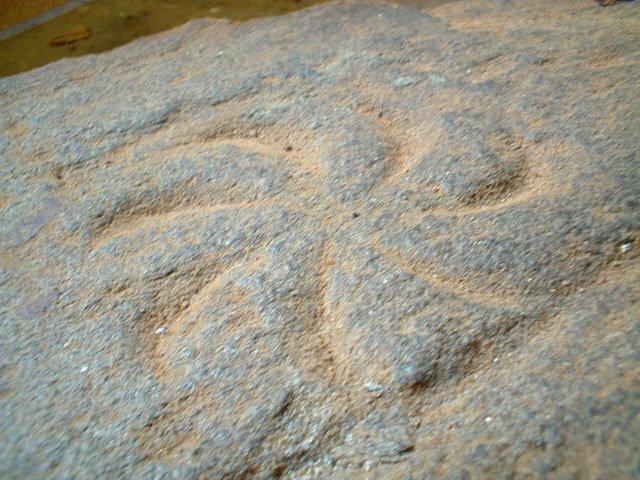
The large slab of stone was literally covered in carvings which seemed to date from many different periods. There was an ancient 'cup' mark, thought to date from Stone Age times, as well as a traditional sun symbol (shown above) There was an obviously Christian cruciform shape; early Celtic saints would often 'christianise' pagan stones by adding appropriate holy symbols, presumably as part of some ceremony of blessing , without defacing the earlier inscriptions.
There were also the faint remains of what may have been a hunting scene (possibly Mediaeval) and another strange outline which looked like nothing so much as a stylised whale. And then there was much later lettering, perhaps added by those who had incorporated this stone into their house - possibly because they recognised its age and sanctity, and thought that it might bring luck to hearth and home. Gazing at this mysterious survival of an ancient, symbolic language, I wondered just how many other magical stones may have been removed from old buildings and carelessly demolished over the years.